

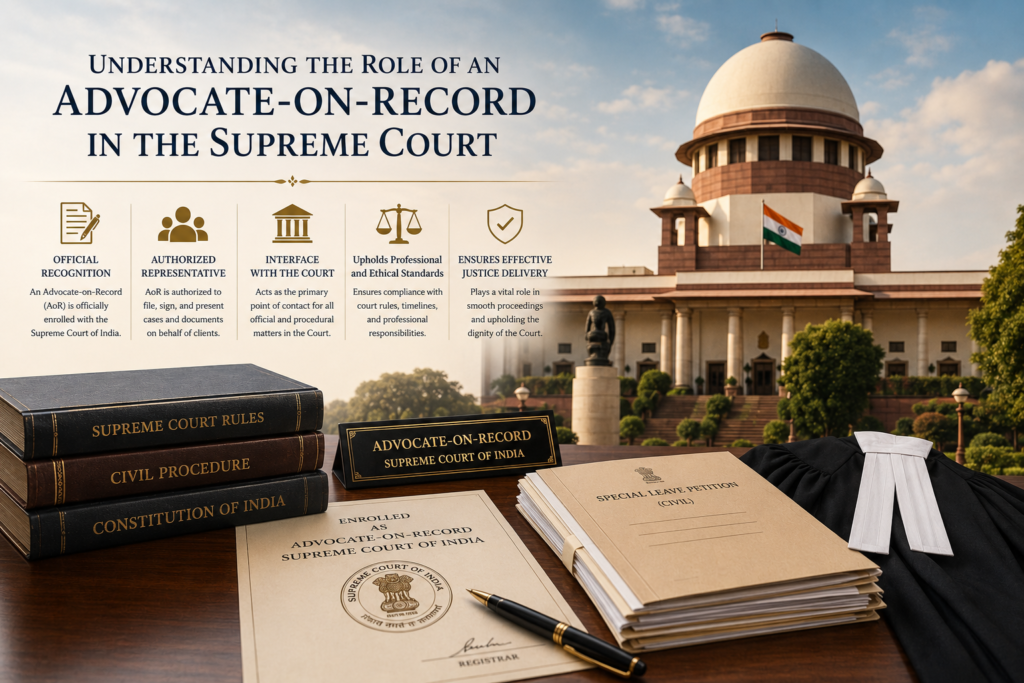
The Supreme Court of India is the apex judicial authority in the country, responsible for interpreting the Constitution and delivering justice in matters of national importance. Unlike other courts in India, the Supreme Court follows a unique procedural framework that requires certain legal formalities to be handled exclusively by an Advocate-on-Record (AOR). This specialized system ensures that every matter filed before the Court meets the highest standards of accuracy, compliance, and professionalism.
An Advocate-on-Record is not just a legal practitioner but a specially qualified advocate authorized to act and file cases before the Supreme Court. Their role is fundamental to ensuring that litigation before the country’s highest court proceeds efficiently and in accordance with the prescribed rules.
Who is an Advocate-on-Record?
An Advocate-on-Record is an advocate recognized by the Supreme Court of India to officially file and conduct cases on behalf of clients. To obtain this designation, an advocate must fulfill specific eligibility requirements, undergo training under a registered Advocate-on-Record, and successfully clear the Advocate-on-Record Examination conducted by the Supreme Court.
The examination assesses an advocate’s knowledge of Supreme Court Rules, procedural law, legal drafting, court practices, and professional ethics. Only those who meet these rigorous standards are granted the privilege of becoming an Advocate-on-Record.
Key Responsibilities of an Advocate-on-Record
The responsibilities of an Advocate-on-Record extend far beyond filing documents. Some of the primary duties include:
- Preparing and filing petitions, appeals, affidavits, and applications before the Supreme Court.
- Ensuring that all documents comply with the procedural requirements prescribed by the Court.
- Coordinating with clients to obtain relevant records and supporting documents.
- Preparing case briefs and assisting Senior Advocates during hearings.
- Communicating with the Supreme Court Registry regarding procedural requirements and case listings.
- Monitoring filing deadlines and ensuring timely compliance with court directions.
These responsibilities make the Advocate-on-Record an essential link between the litigant and the Supreme Court.
Why is the AOR System Important?
The Supreme Court handles matters involving constitutional issues, civil and criminal appeals, public interest litigation, arbitration disputes, and other cases of national significance. Given the complexity of these matters, procedural accuracy is extremely important.
Even a minor error in documentation or filing can result in objections from the Court Registry, leading to delays or additional procedural requirements. An Advocate-on-Record minimizes such risks by ensuring that every filing complies with the applicable rules and regulations before it reaches the Court.
This system benefits not only litigants but also the judiciary by maintaining consistency, reducing procedural defects, and enabling smoother court proceedings.
Working Alongside Senior Advocates
In many significant cases, Senior Advocates present oral arguments before the Supreme Court. However, they generally appear on the instructions of an Advocate-on-Record, who remains responsible for the procedural management of the matter.
The Advocate-on-Record prepares case records, organizes supporting documents, coordinates with clients, and assists the legal team in developing an effective litigation strategy. This collaborative approach ensures that both procedural compliance and legal advocacy receive equal attention.
Benefits for Clients
Choosing an Advocate-on-Record provides several practical advantages for individuals and organizations approaching the Supreme Court, including:
- Accurate and compliant legal filings.
- Reduced risk of procedural delays or defects.
- Efficient coordination with the Court Registry.
- Better case management and documentation.
- Professional guidance throughout the litigation process.
These benefits help clients navigate the complexities of Supreme Court litigation with greater confidence and clarity.
The Advocate-on-Record system is a distinctive feature of the Supreme Court of India that promotes discipline, accountability, and excellence in legal practice. By ensuring procedural compliance, managing documentation, and coordinating every stage of a case, an Advocate-on-Record plays a crucial role in the effective administration of justice.
Whether a matter involves constitutional interpretation, civil appeals, criminal proceedings, or commercial disputes, the expertise of an Advocate-on-Record helps ensure that cases are presented before the Supreme Court in a structured, efficient, and legally compliant manner. Their contribution extends beyond paperwork—they serve as trusted legal professionals who uphold the integrity of the judicial process while safeguarding the interests of those they represent.