

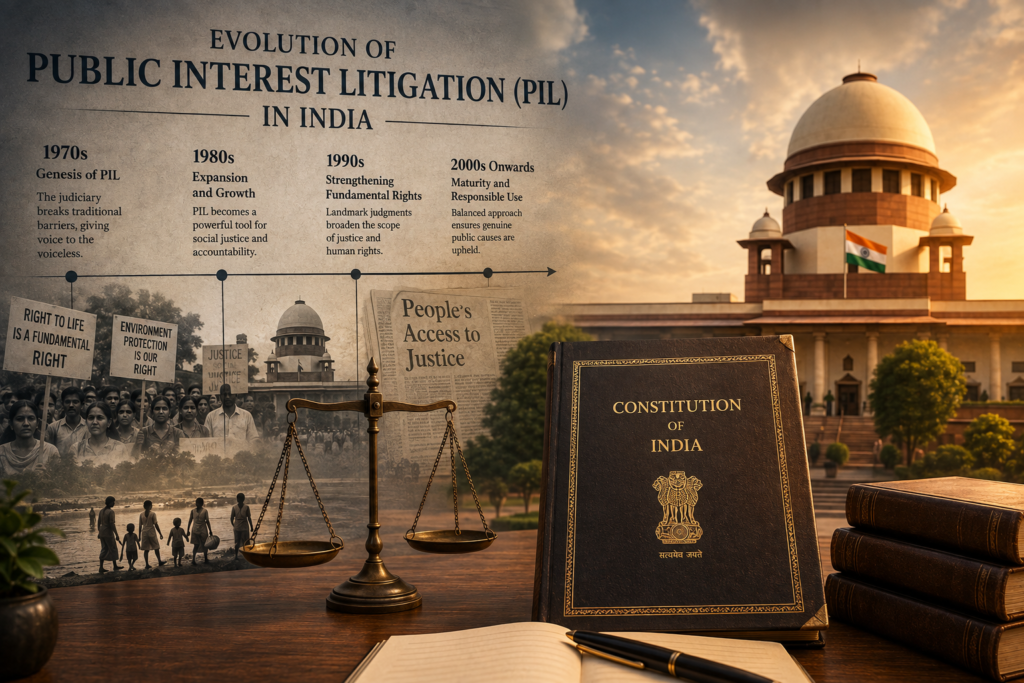
Public Interest Litigation (PIL) is one of the most significant developments in the Indian judicial system. Introduced during the late 1970s, PIL transformed the concept of access to justice by allowing individuals and organizations to approach the courts on behalf of those who were unable to seek legal remedies themselves. Unlike traditional litigation, where only an aggrieved person could file a case, PIL relaxed the rule of locus standi, enabling public-spirited citizens, social activists, and organizations to raise issues affecting the larger public interest.
Over the years, Public Interest Litigation has become a powerful legal tool for protecting constitutional rights, promoting social justice, and ensuring government accountability. It has played a vital role in addressing the concerns of marginalized communities and strengthening India’s democratic framework.
Origin and Development of PIL
The concept of PIL gained momentum through the proactive approach of the Supreme Court of India in the late 1970s and early 1980s. The judiciary recognized that many disadvantaged individuals lacked the financial resources, education, or awareness necessary to approach the courts. To bridge this gap, the courts adopted a more flexible approach, allowing petitions to be filed in matters involving public welfare and fundamental rights.
This judicial innovation significantly expanded access to justice and reinforced the constitutional commitment to equality before the law. It also demonstrated the judiciary’s willingness to play an active role in protecting the rights of vulnerable sections of society.
Landmark Contributions of Public Interest Litigation
During its early years, PIL primarily focused on protecting the rights of marginalized communities and improving public welfare. Several landmark cases laid the foundation for modern PIL jurisprudence.
Notable areas where PIL made a lasting impact include:
- Protection of bonded labour and workers’ rights.
- Improvement of prison conditions and rights of undertrial prisoners.
- Environmental conservation and pollution control.
- Protection of children’s rights and access to education.
- Safeguarding the rights of women and vulnerable communities.
Cases such as M.C. Mehta v. Union of India significantly advanced environmental jurisprudence, while Sheela Barse v. State of Maharashtra strengthened the protection of prisoners’ rights and highlighted the importance of humane treatment within the criminal justice system.
Expanding Scope of PIL
As Indian society evolved, the scope of Public Interest Litigation expanded far beyond its original objectives. Today, PILs have contributed to judicial intervention in a wide range of issues that directly affect public welfare and constitutional governance.
Some of the important areas addressed through PIL include:
- Environmental protection and sustainable development.
- Public health and healthcare infrastructure.
- Education and children’s welfare.
- Gender equality and women’s rights.
- Transparency and accountability in governance.
- Consumer protection and public safety.
- Protection of fundamental rights.
Through these interventions, courts have not only resolved disputes but have also encouraged policy reforms and improvements in public administration.
Challenges and Responsible Use of PIL
While Public Interest Litigation has become an effective instrument for social justice, courts have also recognized the possibility of its misuse. In some instances, PILs have been filed for personal interests, political motives, or publicity rather than genuine public welfare.
To preserve the credibility of this legal mechanism, the judiciary has consistently emphasized that PIL should only be invoked for matters involving genuine public interest. Courts carefully examine the intent behind such petitions and discourage frivolous or motivated litigation that unnecessarily burdens the judicial system.
This balanced approach helps ensure that PIL continues to serve its original purpose of protecting constitutional rights and promoting social welfare.
Importance in Indian Democracy
Public Interest Litigation has become an integral part of India’s constitutional framework. It reflects the judiciary’s commitment to ensuring that justice is not limited to those who possess financial resources or legal knowledge. By providing a platform for addressing issues affecting disadvantaged communities, PIL strengthens the principles of equality, fairness, and the rule of law.
It has also encouraged greater governmental accountability by enabling judicial review of administrative actions and public policies that impact citizens. Through PIL, courts have played a constructive role in promoting transparency, protecting the environment, and safeguarding fundamental rights.
The evolution of Public Interest Litigation marks one of the most progressive chapters in India’s legal history. By relaxing procedural barriers and expanding access to justice, PIL has empowered citizens to seek judicial intervention in matters affecting society as a whole. From protecting the environment and improving prison conditions to advancing education, healthcare, and human rights, PIL has significantly contributed to India’s social and constitutional development.
Although safeguards against misuse remain essential, Public Interest Litigation continues to be a powerful instrument for achieving social justice and upholding constitutional values. As India continues to evolve, PIL will remain an indispensable mechanism for ensuring that the promises of the Constitution reach every section of society, particularly those who need legal protection the most.